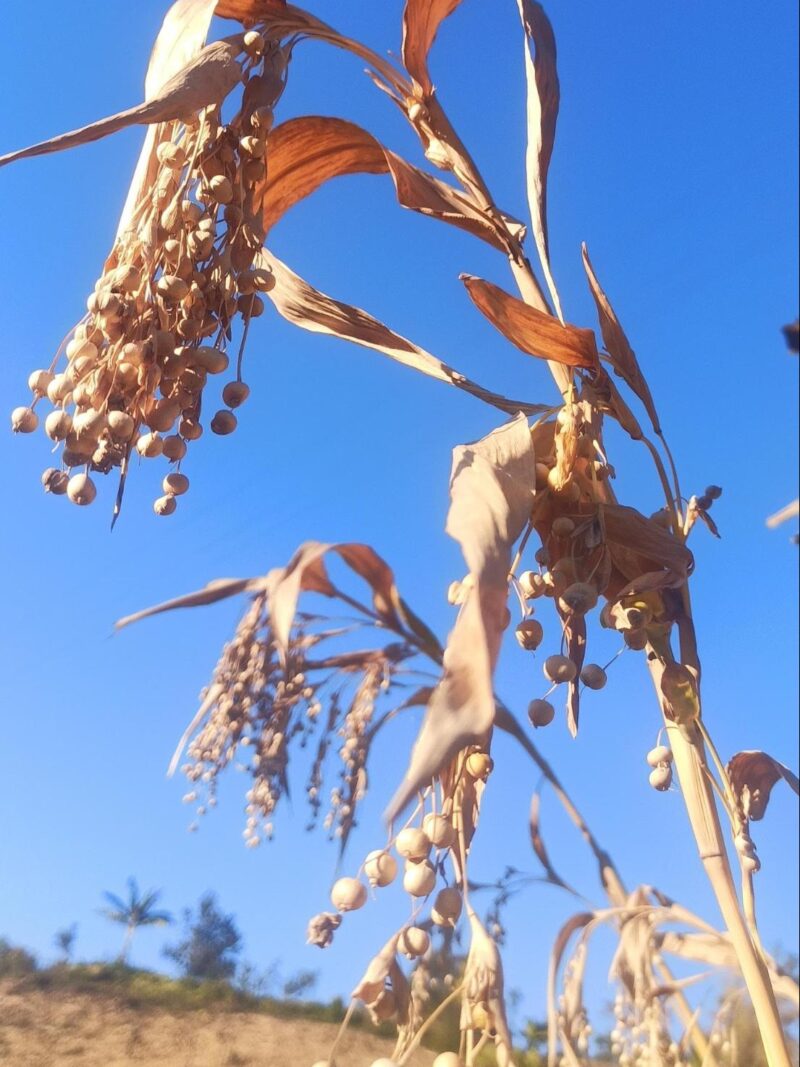
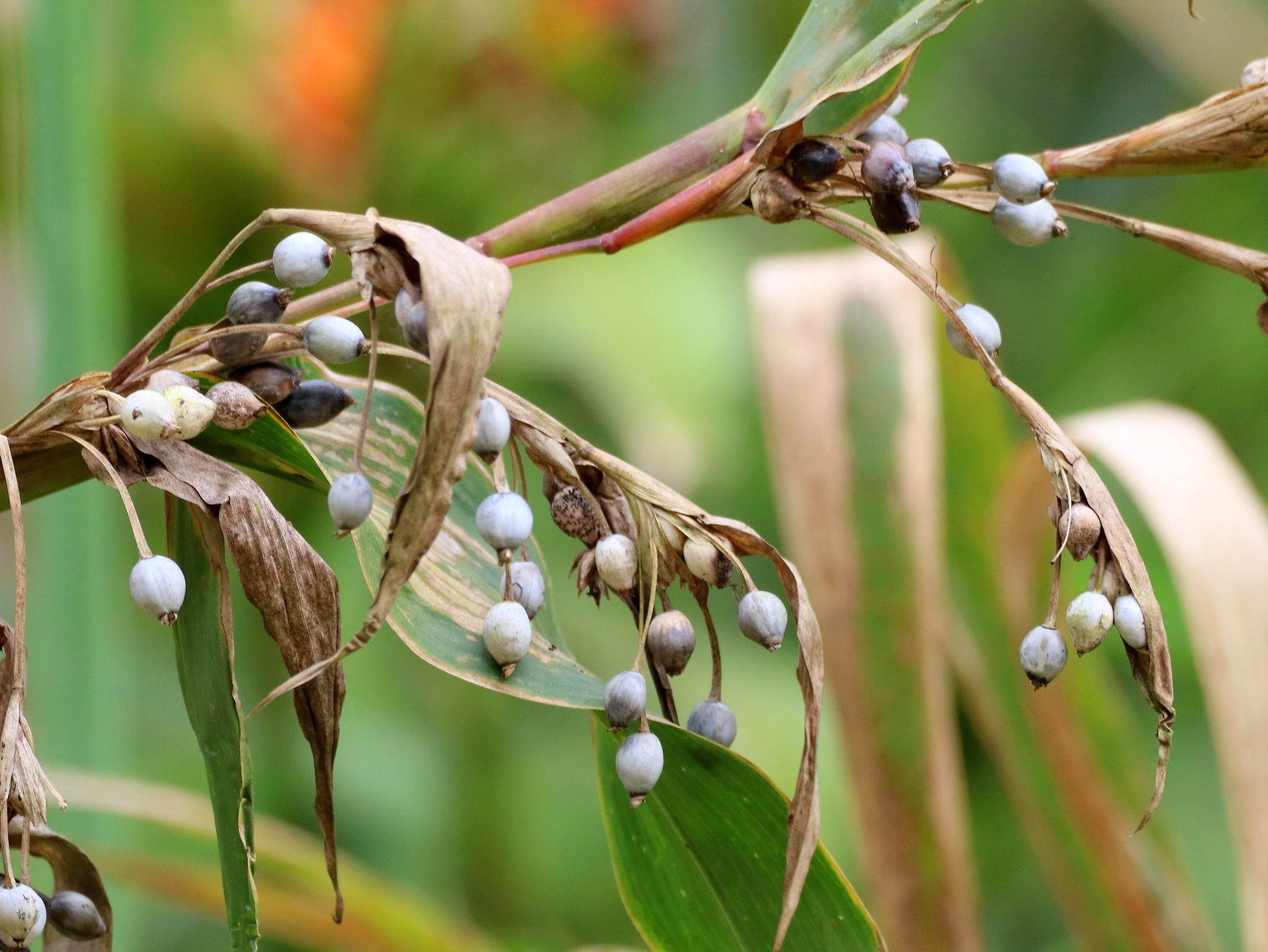
The mountainous terrain of the Adi Pasi village and its black soil is considered ideal for growing diverse millets, including Anyat, popularly known as Job’s Tears. Photo By Vinicius S Domingues, CC BY 4.0 License.
Life within the Adi Pasi community centers around growing regional millets like Job’s Tears. Marina Dai reports from the fields of Upper Siang district on shifting agricultural practices and a new generation’s efforts towards reviving the grain.
In Adi Pasi Sibuk village in Arunachal Pradesh, 29-year-old Ani Dai makes her way to her family’s field, three kilometres from her home. On her back, a baye (traditional bamboo basket) carries seeds and tools. Ani is a farmer who has been practising millet cultivation since childhood. “I learned everything from my parents. We grew Mirung or finger millet, and Anyat, popularly known as Job’s Tears,” Dai said.
In her village in the Upper Siang Valley, residents welcome the new sowing season every April-May with enthusiasm. They observe Unying Aran, a festival that is the harbinger of farming activities for the year. Households stir with preparations for jhum (slash and burn cultivation), a practice deeply embedded in their lives.
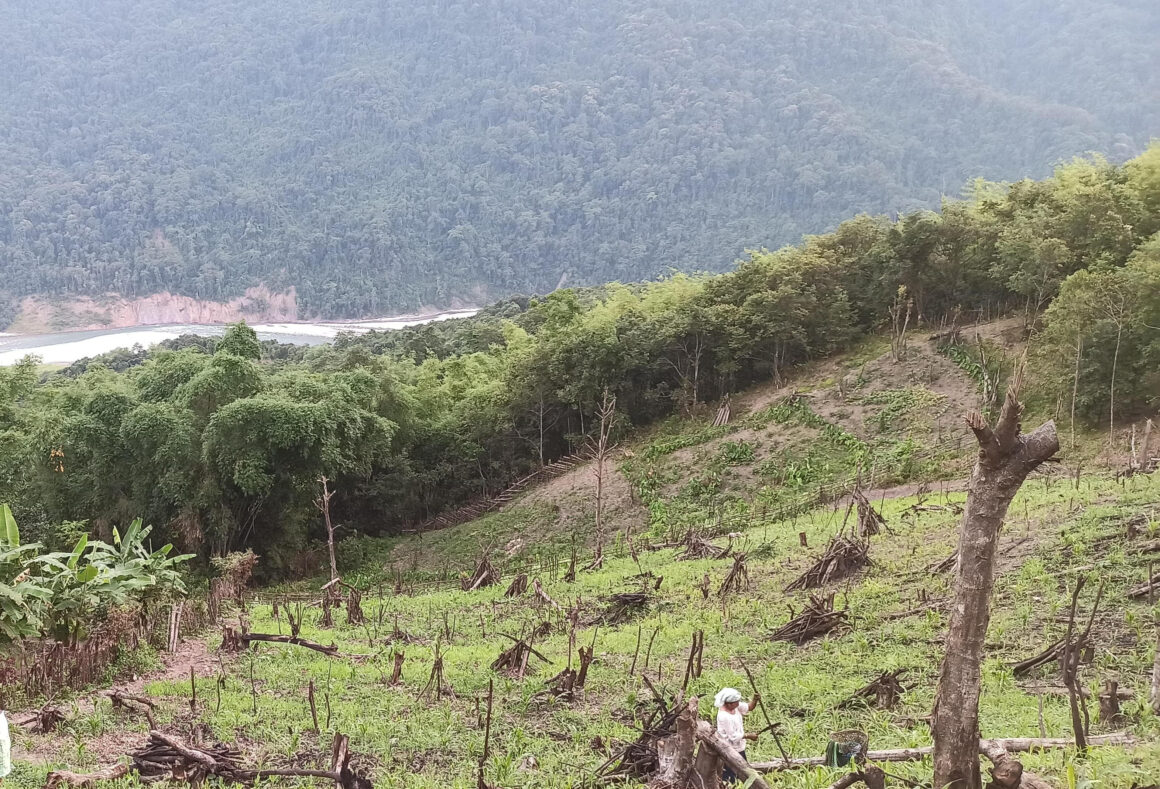
The jhum method entails burning and clearing about 10 hectares of hillside during Rikpa Panam, or the ritual of ‘clearing forest for cultivation.’ Once the land is cleared by the farmers, the community waits for around two months to welcome Anyat Sitnam, a festival to celebrate “sowing of seeds in the field.” The seeds sown include sapa ( maize), enge (taro root), En:gin (sweet potatoes) and ayak (foxtail millet). After working in the fields, the community gathers together to celebrate this period with beer brewed from finger millet known as Mirun Apong and eating different kinds of meat including that of the Drung ox.
For farmers like Ani Dai, farming is not just an occupation but a way of carrying forward the culture and traditions passed down by her elders. “We used to work together with friends, moving from one field to another, helping each other sow and later harvest the crops. In our culture, there is no strict division of labour; men and women both work side by side in the fields,” she said. “The joy was not just in the food we grew but in the way we worked together.”
The work of sowing is followed by the process of protecting and caring for the crops. In another festival called Etor, celebrated in the month of May, the community fences the recently generated fields; once dusk settles, the villagers celebrate with various folk activities from the Adi Pasi community, including the Tapu dance.
The Pasi community is one of the many subtribes of the Adi Tribe of Arunachal Pradesh. ‘Adi’ which translates to ‘hill people’, includes other subtribes such as the Padams, Milangs, Komkars, and Minyongs. One of the state’s 26 tribes, the Adi population comprises around 68,000 people in Arunachal Pradesh, out of which, around 3,000 belong to the Pasi community, according to the 2011 census. The Adi Pasi Sibuk Village in Siang district is home to 721 people from the Pasi community. Agriculture remains the population’s main source of livelihood and millets are a key crop for sustenance. The mountainous terrain of the Adi Pasi village and its black soil is considered ideal for growing diverse millets like Anyat, Ayak, and Mirung.
In our culture, there is no strict division of labour; men and women both work side by side in the fields. The joy was not just in the food we grew but in the way we worked together.
After tending to the crops for months, it is time for the community to come together to pray for a good harvest and gather the yield. Some crops like Ayak, that mature in three months, are harvested around August or September. Others like Anyat, which take eight to nine months, are harvested between December and January.
After the harvest, the land used under jhum cultivation is left fallow to allow it to regenerate. Crops such as Mirung, that do not require a long fallow period, are grown again in the same cleared field during the next cultivation cycle. However, other crops such as Anyat and others like maize, sweet potatoes, and taro, require the land to rest and regenerate for a longer period. For these crops, the field is left fallow for at least 12 years.
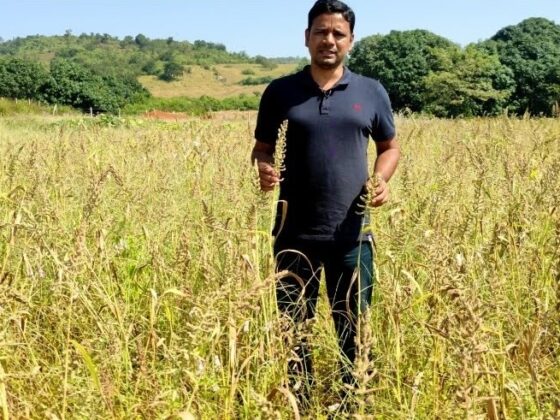
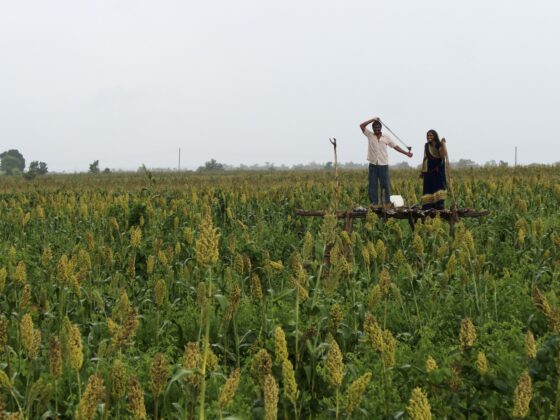
A field of Job’s Tears (Anyat) intercropped with maize in Mariyang, Upper Siang district, Arunachal Pradesh. All Photos by Marina Dai.
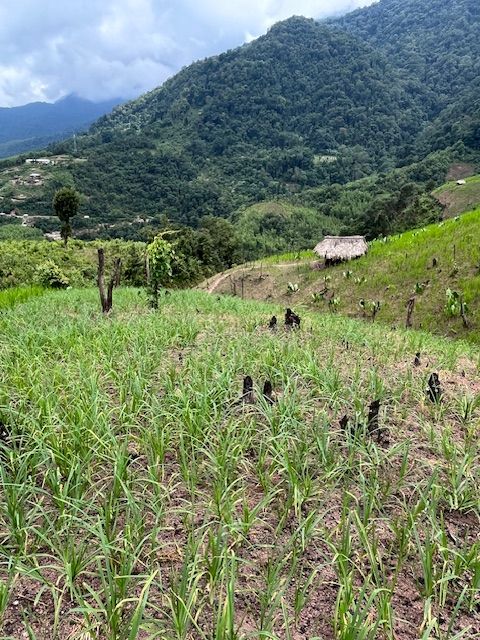
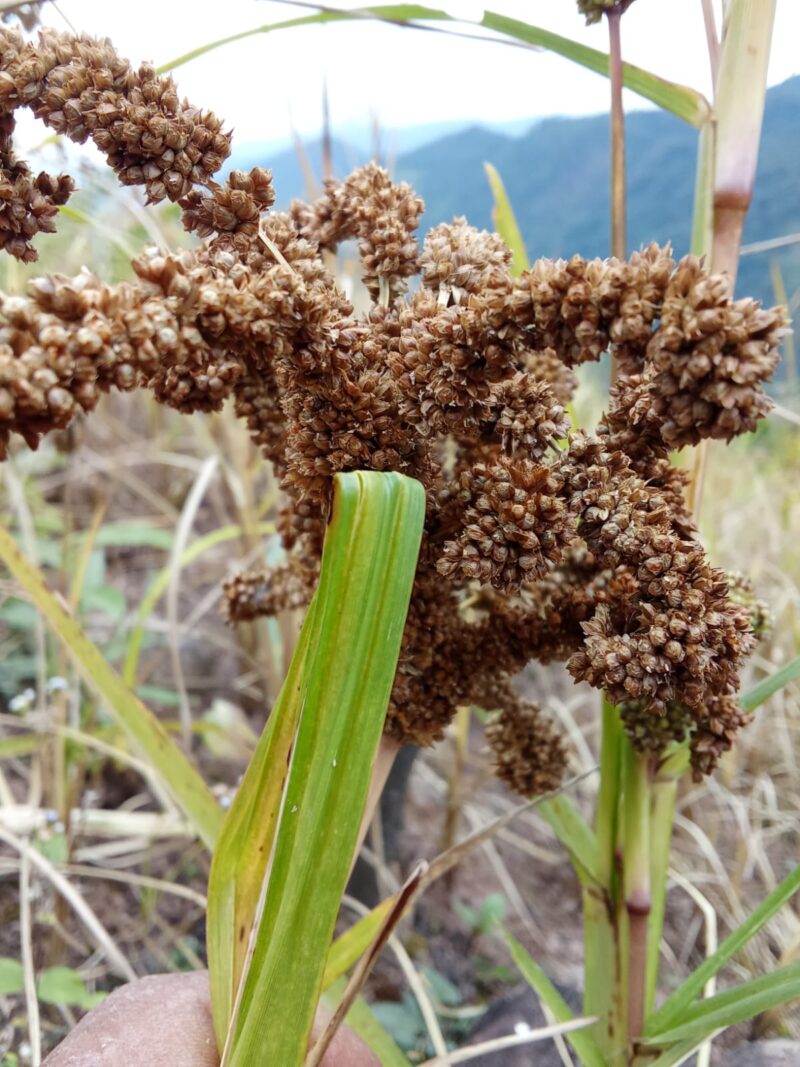
A jhum field comprising finger millet, locally known as Mirung, in Adi Pasi Sibuk village.
Mopi Arik (jhum cultivation) field in Adi Pasi Sibuk village in Upper Siang District in Arunachal Pradesh.
“Pasi people have practised jhum cultivation for generations,” said 45-year-old Kolyon Moyong, a teacher in the Adi Pasi Sibuk village. According to Kolyon, before terrace farming arrived in the late 20th century, the Pasi people practised a 12-year jhum rotation cycle. Each area, known as ‘patat’, was cleared, cultivated, and then left to regenerate. “Villagers even used the order of the patat to calculate a person’s age in the absence of written records,” Moyong shared.
Millets like Anyat and Mirung were the Pasi community’s staple foods, also used for medicine and rituals, Kolyon added. For instance, millet flour was ground traditionally in a wooden mortar and used to make ‘runyot,’ a type of roti eaten for breakfast. “They kept our forefathers healthy, helping them live long, disease-free lives,” Kolyon said.
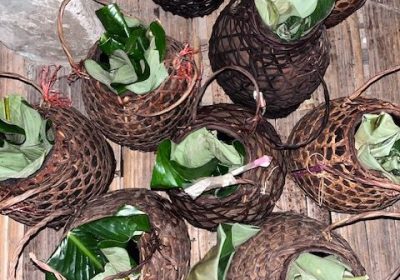
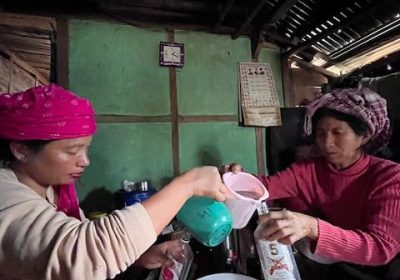
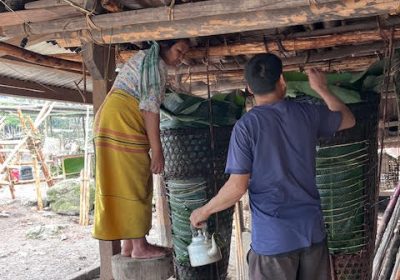
Beyond food, Mirun Apong, the local wine made from Mirung (finger millet) is believed to attract the spirits of the hills, mountains, rivers, and forests during agricultural festivals such as Solung—celebrated in September upon the completion of sowing—and Unying-Aaran—marking the beginning of farming activities in March. It is even used in rituals to ensure a good harvest and the wellbeing of livestock. To brew the Mirun Apong, large pots are placed over open fires as water is boiled. Cone-shaped bamboo baskets lined with leaves hold the fermented millet, into which the hot water is poured. Both men and women take part in the preparation. After the brewing process, women carefully pour the wine into epum—a traditional container used for storing the drink. It is then offered to relatives for the strengthening of family relationships.
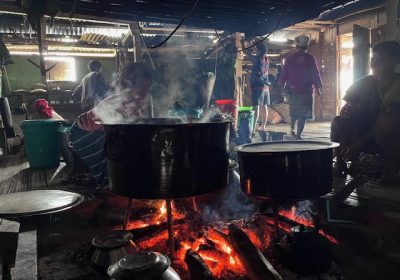
To prepare Mirung Apong, first water is boiled in large pots placed over open fires.
The boiling water is then mixed with the fermented millets in Cone-shaped bamboo baskets lined with leaves.
Apong is then poured into epum, a traditional container.
The wine is usually served among family members at special occasions and rituals like weddings.
Today, millet cultivation among the Adi Pasi community is declining with the introduction of wet rice cultivation (WRC) and terrace farming, according to Kolyon. Millets have largely been replaced by paddy. “Millets are mostly used for making apong instead of being eaten as staple food,” he adds. “Terrace farming brought self-sufficiency in crop production. But jhum cultivation has been an important part of our history and culture.”
Thirty kilometres from Adi Pasi Sibuk, in the town of Mariyang, 26-year-old Yangki Pertin has also been growing Anyat with her parents using the jhum method. “My elders taught me. I remember going to the fields after school to help my parents during the harvest every year in December. My sisters and I loved helping them out,” Yangki said. “Anyat holds strong cultural significance—it is a crop tied to our identity, and many farmers feel a sense of reconnection to their origins through its cultivation,” she adds.
Before rice cultivation became commonplace in Mariyang, and Anyat was still the staple food, the village elders would inspect the fields and announce when it was time to gather the harvest. “That was a moment of joy for us,” Yangki said. She, along with her siblings, would pound Anyat in a wooden mortar; sometimes the children would make beads out of the millet grains and play with them. It was also common for families in the town to cook Anyat with rice and eat together. “My grandparents didn’t eat rice at all; they lived on millets. Rice was reserved for guests,” Yangki adds. “Today, Anyat does not grow in quantities and is mostly fed to pigs or to make Apong.”
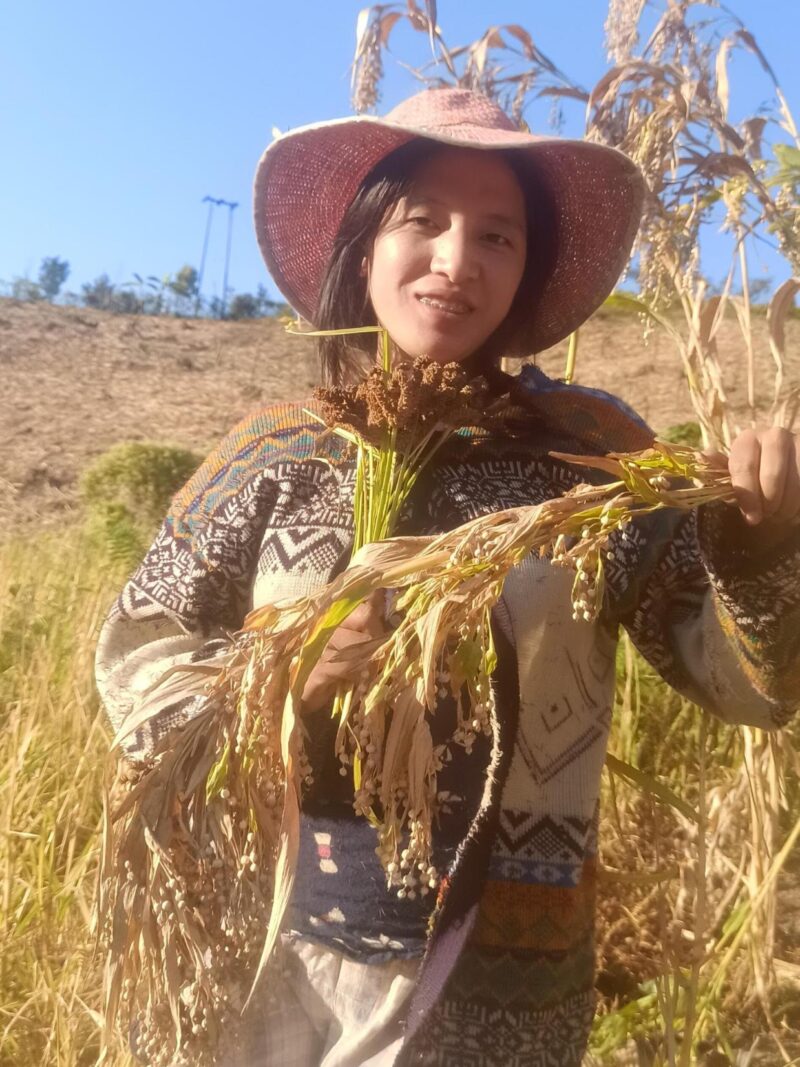
Yangki Pertin holding Job’s Tears, known as Anyat millet in Arunachal Pradesh, and finger millet, or Mirung, growing in a field in the village of Mariyang.
There is a mythology surrounding the origin of millets among the Adi Pasi population. According to a 60-year-old individual from Damro village who prefers not to be named, it is believed that Pedong Na:ne (mother of all creatures), and her husband Yi:dum Bote, once hosted a great feast known as ‘Sobo Panam’, inviting all beings, including Ki:ne Na:ne (the goddess of food and grains) to her kingdom (Siking Koje Di:dum). During the feast, a mighty mithun (Drung ox)-like creature, Dende Sobo, was sacrificed. As its body parts scattered, they gave rise to various beings and crops. It is believed that Ki:ne Na:ne carried Dende Sobo’s tail, scrotum, and bone marrow to the underworld, where they transformed into crops including Anyat, Ayak, and Sapa. According to mythology, these crops were then carried through the ears of Sanyi Kibo (a dog) and delivered from the underworld to Engo Takar (humankind). Based on this myth, the essential crops of the Adi Pasi people are considered sacred gifts from Dende Sobo, forever tying millets to spirituality and sustenance.
Anyat holds strong cultural significance—it is a crop tied to our identity, and many farmers feel a sense of reconnection to their origins through its cultivation.
Today, the world is re-developing an interest in millets because of their health benefits, something the Adi Pasi people have always known. “Buyers approach us for millet-based products so some farmers are now exploring more extensive farming methods to increase production and income,” Yangki said.
“For the future, I want young people to understand the value of millets. The joy of going to the fields with friends, relatives, and neighbours is special. I hope the younger generation preserves this culture,” she adds.
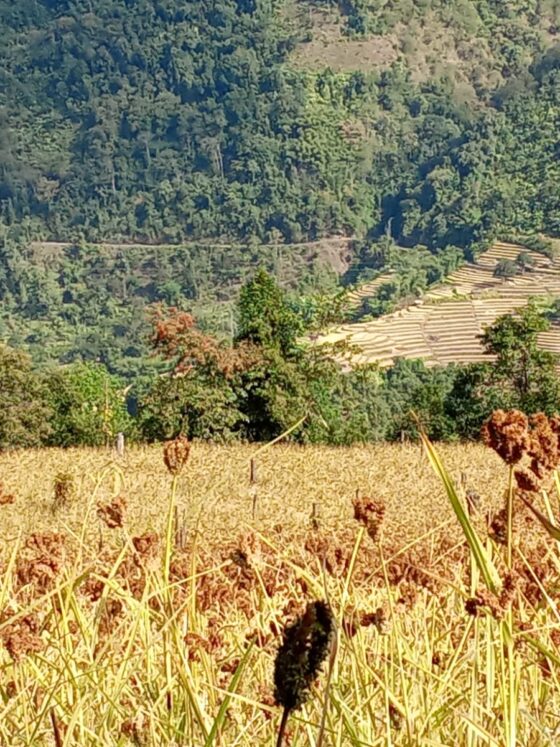
Job’s Tears (Anyat ) and finger millet (Mirung ) grown in the Yamne river belt.
Located along the Siang river, it is a region suitable for growing diverse millet crops.
A new generation of the Adi Pasi community is also working to bring millets back. In Lower Dibang Valley, 32-year old Dimum Pertin runs Gepo Ali, a startup promoting Anyat millet in collaboration with local farmers and women’s groups. “The younger generation barely knows anything about Anyat,” she said. “That’s why I focus on this variety. Other millets are found across India, but Anyat is unique to Arunachal Pradesh. Reviving it means preserving our identity and protecting our ecosystem.”
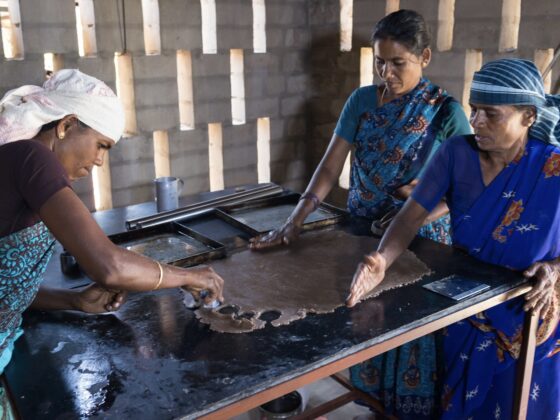
Initially Dimum focused on selling Anyat as grain in the commercial market. But she soon realised “its deeper value lay within the community itself.” However, bringing Anyat to younger generations has proved to be a challenge. “While elders enjoyed Anyat, young people showed little interest,” she said. This prompted her to begin the process of adding Anyat into cookies, crackers, and bread. To sustain the effort, she also launched a seed bank in 2024. “We invite women to learn and train in processing Anyat into new products, creating a shared space for knowledge, tradition, and innovation,” Dimum said. Today, around 30–35 women are part of this collective.
For Dimum, the inspiration to learn about millets comes from her grandmother, Mati Pertin. The urge was sparked when Mati declared she wanted to eat plain cooked Anyat—or ‘Anyat Apim’, something she had enjoyed in her childhood. “Her memories of Anyat made me want to understand its role as a staple food. Families were still producing it using seeds that had been stored, and I felt compelled to preserve that link to the past,” Dimum concludes.
Marina Dai is a freelance journalist based in Arunachal Pradesh, reporting on
indigenous issues and climate change. She is an AIIP–EastMojo Fellow (2024), an
Impulse Model Press Lab Fellow, and a mentee under the Climate Change Media Hub
Programme at the Asian College of Journalism (ACJ), Chennai, in collaboration with
Interlink Academy, Germany.
This article is part of the Millet Revival Project, The Locavore’s modest attempt to demystify cooking with millets, and learn the impact that it has on our ecology. This initiative, in association with Rainmatter Foundation, aims to facilitate the gradual incorporation of millets into our diets, as well as create a space for meaningful conversation and engagement so that we can tap into the resilience of millets while also rediscovering its taste.
Rainmatter Foundation is a non-profit organisation that supports organisations and projects for climate action, a healthier environment, and livelihoods associated with them. The foundation and The Locavore have co-created this Millet Revival Project for a millet-climate outreach campaign for urban consumers. To learn more about the foundation and the other organisations they support, click here.




 Login with Google